
The Leapfrog Hospital Survey uses national performance measures to evaluate individual hospitals on safety, quality and efficiency. Data and findings from the Survey provides consumers with potentially life-saving information on hospital quality. The measures included on the Hospital Survey are predicated on the latest science and are selected with guidance from scientific advisors at the Armstrong Institute for Patient Safety at Johns Hopkins Medicine as well as Leapfrog's volunteer Expert Panels.
About Central Line-Associated Bloodstream Infections
Some patients need a central line, a tube inserted into the body, to deliver medication and other treatments. Patients with a central line are at high risk for developing a dangerous infection in the blood known as a central line-associated bloodstream infection (CLABSI).
These infections can increase recovery time and even lead to death. Leapfrog publicly reports a hospital's observed number of infections with an expected number of infections that takes into account certain hospital characteristics like their status as an academic medical center to result in a standardized infection ratio (SIR) through the CDC’s National Healthcare Safety Network.
.
How a Hospital in New Jersey Reduced Central Line-Associated Infections
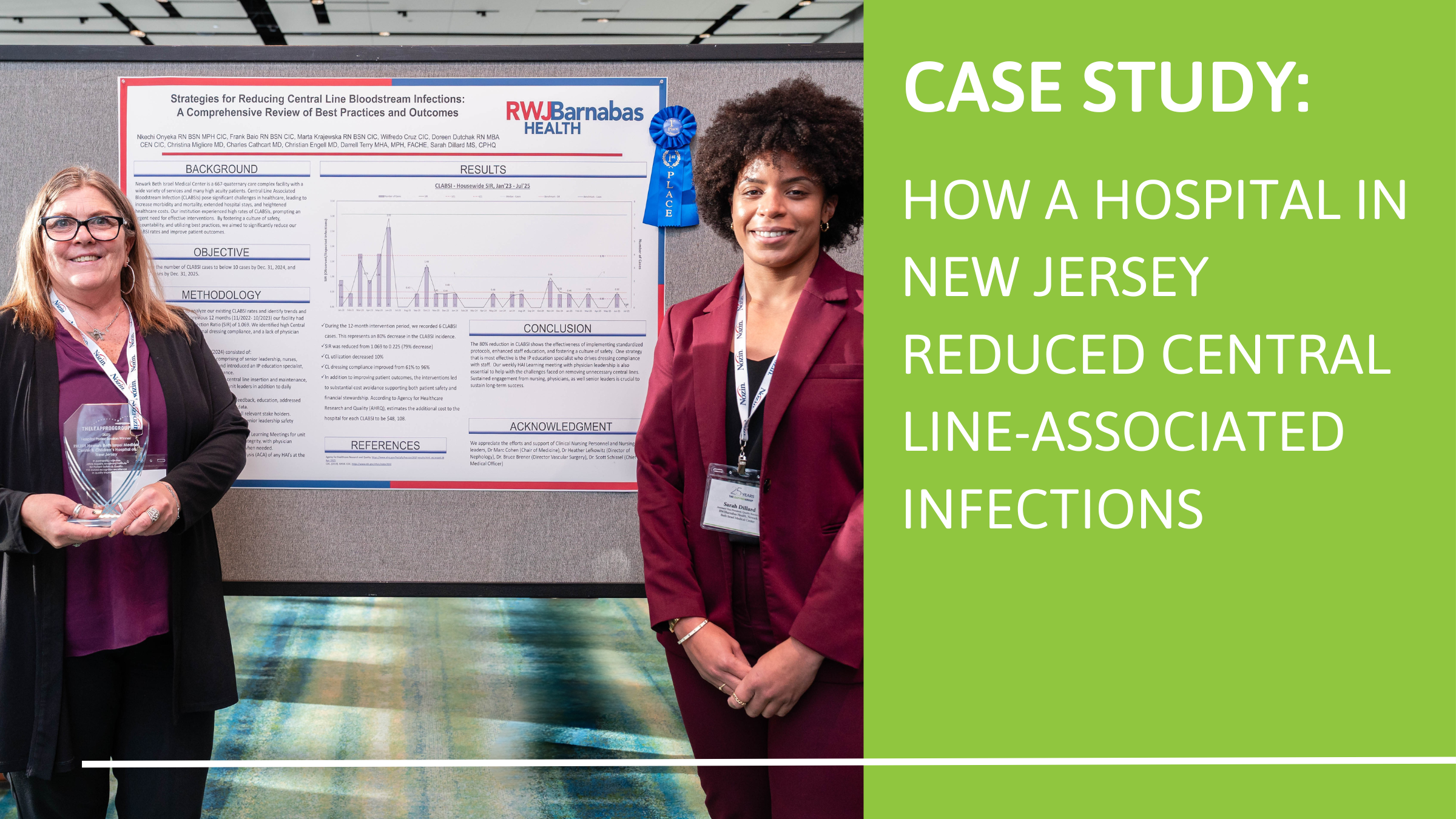
 In 2025, Newark Beth Isreal Medical Center, in New Jersey, received recognition at the Leapfrog Annual Meeting for presenting the top-scoring hospital poster in Leapfrog’s second-ever poster session. Their presentation highlighted impressive reductions in the hospitals central line-associated bloodstream infections.
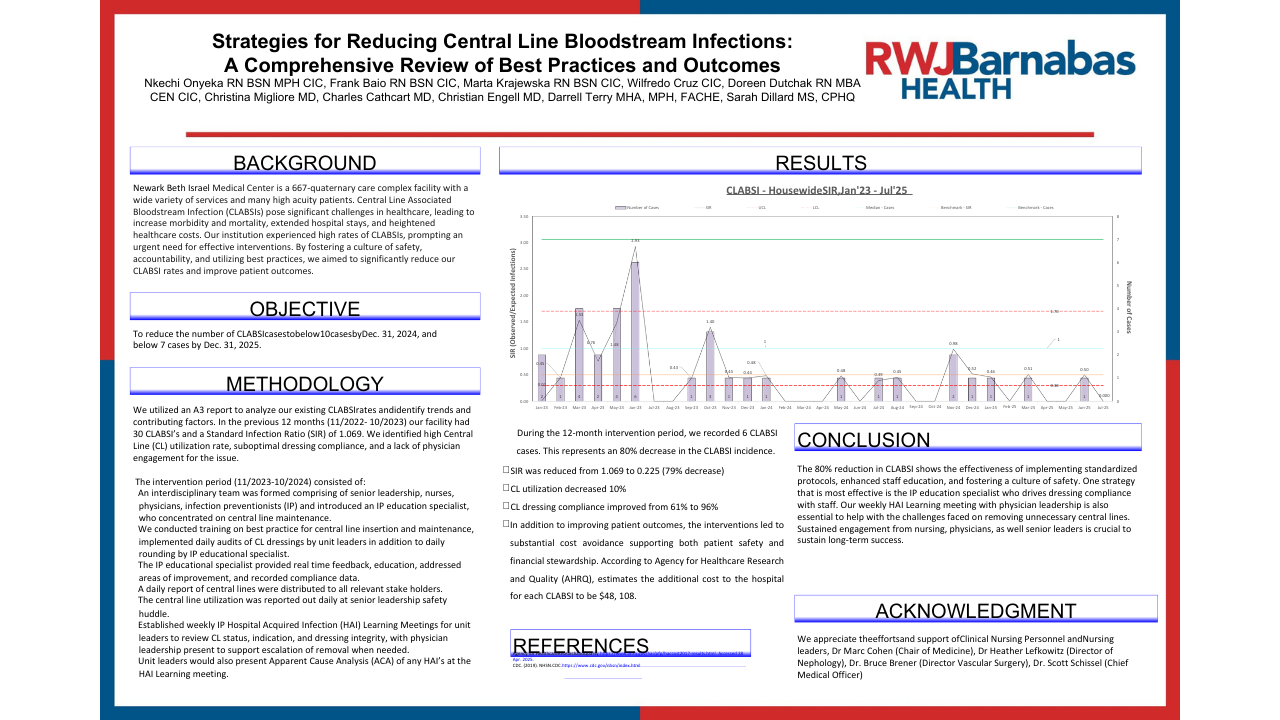
Click here to expand poster to full screen view.
In this interview, Leapfrog's team discusses Newark Beth Isreal Medical Center's Medication safety improvement efforts with Doreen Dutchak,Vice President of Quality and Safety.
In this interview, Leapfrog’s team discusses Newark Beth Isreal Medical Center's medication safety improvement efforts with Doreen Dutchak, Vice President of Quality, Safety and Experience at Newark Beth Isreal Medical Center.
Tell us about your hospital and the communities you serve as background.
- Doreen Dutchak: Newark Beth Israel Medical Center is a 665-bed regional care teaching hospital that is part of the RWJBarnabas Health system, New Jersey’s largest and most comprehensive academic health system. We care for patients from across the greater Newark, New Jersey, region, as well as the state of New Jersey.
Your hospital won the top poster award at the 2025 Leapfrog Annual Meeting for your work to decrease Central Line Bloodstream Infections. Tell us more about this work.
- Doreen Dutchak: The poster presentation was the result of Newark Beth Israel’s commitment to reducing CLABSIs, which had reached a high of 23 in 2023. By the end of 2024, the hospital, led by its Infection Prevention team, had reduced the number of CLABSIs by 80%, and the outcomes were sustained into 2025. By focusing on daily monitoring, daily reporting, real-time education, feedback, and interdisciplinary collaboration, the team not only reduced the number of infections but also reduced the number of central lines in place by 10%, improved central line dressing compliance reaching up to 96%, and, most importantly, improved patient outcomes.
How did you decide who to recruit for your interdisciplinary team that lead this work?
- Doreen Dutchak: Guided by the high reliability organization principle of deference to expertise, we intentionally recruited a multidisciplinary team. The team included representation from infection prevention, providers, nursing, environmental services, laboratory, pharmacy, front line staff and Quality. Each team member brought their unique care delivery experience and perspective to the table, ensuring that we gained a comprehensive understanding of our opportunities across the continuum and that we could anticipate any potential risks. In addition, by bringing operations and bedside experts together we heightened our collective awareness of additional vulnerabilities that could potentially impact patient safety. Preventing harm and improving performance cannot be achieved through one lens.
Can you discuss more about the weekly infection prevention meeting you enacted and how they impact patient safety and infection prevention?
- Doreen Dutchak: Our weekly infection prevention huddles remain a critical operational venue to discuss real time opportunities and strategies for improving patient outcomes. We discuss current patients, active devices, isolation needs and environmental concerns in real time as opposed to retrospectively. These huddles give us the opportunity to explore opportunities to improve systems and effect sustainable change within the organization. The team collaboratively reviews risks, removes barriers, and escalates concerns in real time. The huddle provides a forum for early intervention, stronger accountability and measurable reduction in hospital acquired infections.
How do you encourage staff at all levels to embrace transparency?
- Doreen Dutchak: Newark Beth Israel Medical Center is a high reliability organization committed to reaching zero preventable harm events. We foster transparency by reinforcing psychological safety and encouraging staff to report near misses, speak up about concerns, and participate in safety discussions without the fear of blame. We encourage keeping the patient at the center of all that we do. To that end, we hold daily Safety Huddles with a multidisciplinary team of leaders to review and address safety concerns. These Safety Huddles are replicated on all inpatient and outpatient units to further encourage transparency and accountability at a granular level. We instituted a Good Catch program, to reward staff members who report errors and near misses, and who stop-the-line for safety. We also have an active Safety Coach program which consists of staff who volunteer to reinforce safety behaviors on their units and in their departments. In addition, our senior leadership team is highly engaged in daily rounding, where they meet with frontline staff to reinforce our safety behaviors and the core values of our organization.
What motivates your hospital to participate in the Leapfrog Hospital Survey?
- Doreen Dutchak: Newark Beth Israel is committed to delivering safe, high-quality care to every patient who walks through our doors. The Leapfrog Hospital Survey aligns with our journey toward becoming a high reliability organization. Leapfrog provides an external, evidence-based framework that challenges us to examine our processes and outcomes through the lens of patient safety and reliability. Leapfrog is a data-driven and highly regarded public measure of that commitment, that provides an additional level of transparency and public acknowledgement of our dedication to excellence.
We embrace Leapfrog as a tool that complements our dedication to reporting, hardwiring best practices, and holding ourselves accountable to the highest standards. How do you engage staff and leadership in meeting Leapfrog’s standards and improving performance?
- Doreen Dutchak: Our Leapfrog Hospital Survey results and efforts are shared at all Board meetings, senior management meetings, department meetings, performance improvement committee meetings, leadership forums, daily leader safety huddles and local department huddles to connect the quality measures to patient outcomes. When we can connect the Leapfrog data to real patient events, it drives staff understanding of how their daily work connects to the Leapfrog score and ultimately our journey towards achieving zero preventable harm events.
What advice do you have for other hospitals interested in improving infection rates and participating in the Leapfrog Hospital Survey?
- Doreen Dutchak: We encourage an unwavering commitment to reporting errors, owning your current state, and being transparent. Infection prevention thrives in an environment where speaking up and cross checking is expected and valued. This will allow you to build reliable systems and strategies and anticipate harm before it occurs. Infection prevention is every team member’s responsibility, so build a multidisciplinary team that can adopt a systems approach to creating sustainable improvements. Adopt a reluctance to simplify problems by examining workflows, ensuring equipment/supply availability, implementing strong hand off processes and including environmental factors. Lastly, remember that the Leapfrog Survey is an accountability tool that can keep you and your teams on track. Through daily reviews of the survey domains, you foster connections within your teams and unlock the power that comes from connecting the data to our mission as healthcare professionals.
Leapfrog Team: Thank you for your time and leadership, Doreen! And thank you to the Newark Beth Isreal Medical Center for its innovative work to improve infection rates as well as the safety and quality of patient care.