
The goal of the Leapfrog ASC Survey--as well as the Leapfrog Hospital Survey-- has always been the same: give the public meaningful, independent ratings to help them make informed decisions about where to receive their health care. Learn more about Leapfrog's major redesign of the ASC Survey.
Leapfrog Medication Documentation Standard
Leapfrog collects information from ASCs about medication documentation. Medication errors are common serious errors that can occur in surgery centers. Medication errors and adverse drug events are more common with longer procedures involving more medication administrations, such as the administration of anesthesia medication.
Clinicians are responsible for documenting all medications and allergies before performing a procedure on a patient and all medications administered during the procedure and newly prescribed at discharge to reduce medication errors and adverse drug events. This measure assesses the percentage of same-day surgery patients who had complete medication documentation including home medications, visit medications, and allergies/adverse reaction(s) in the patients’ clinical record.
How an ASC Enhanced and Improved the Completeness of Medication Safety Documentation
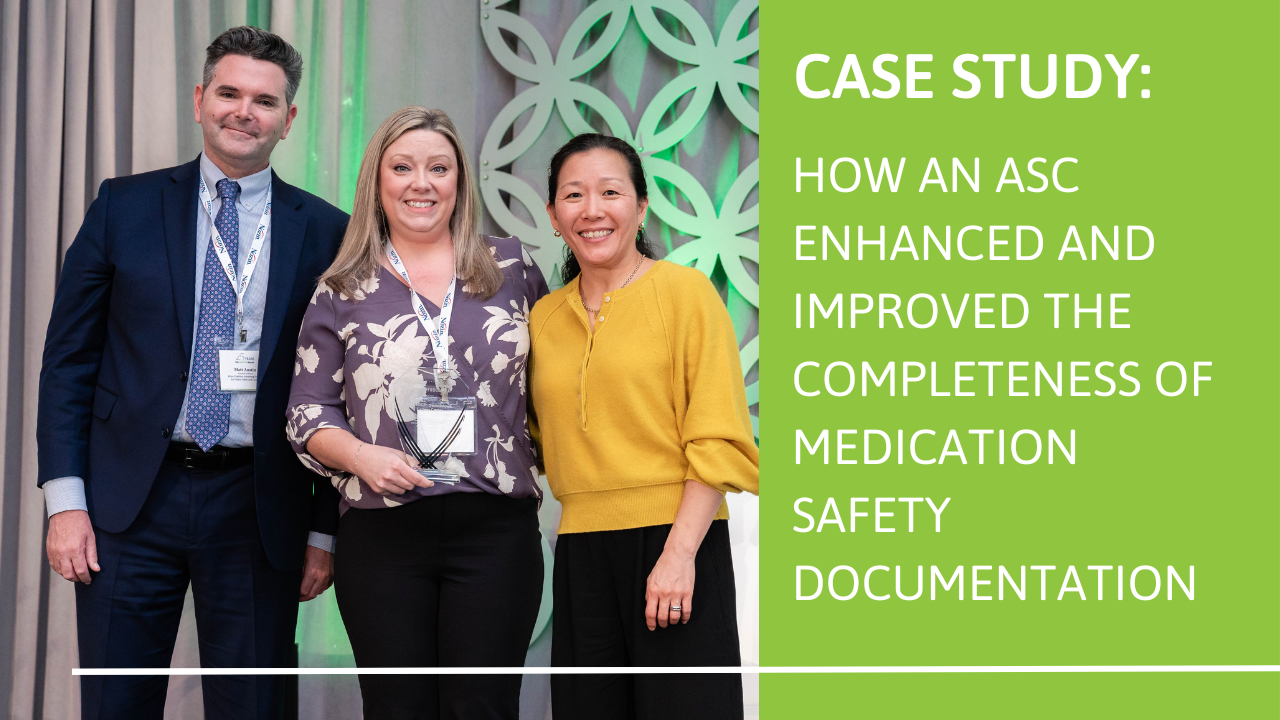
 In 2025, OrthoSouth Surgery Center Germantown in Germantown, Tennessee, received recognition at the Leapfrog Annual Meeting for presenting the top-scoring ASC poster in Leapfrog’s second-ever poster session. Their presentation highlighted impressive improvements in the ASC's medication documentation standard.
Click here to expand poster to full screen view.
In this interview, Leapfrog’s team discusses OrthoSouth Surgery Center Germantown's medication safety improvement efforts with Ashley Bennet, Quality Director of their ASC Division.
Leapfrog Team: Tell us about your surgery center and the community you serve as background.
Ashley Bennet: OrthoSouth, formed in 2019 from the legacies of Memphis Orthopedic Group, OrthoMemphis, and Tabor Orthopedics, represents more than 80 years of orthopedic excellence, providing advanced orthopedic, spine, and pain management care to patients across Shelby County, Tennessee; DeSoto County, Mississippi; and the greater Mid-South. Our mission is to deliver high-quality, patient-centered care that improves mobility, function, and quality of life in the communities we serve.
Leapfrog Team: Your surgery center won top poster award at the 2025 Leapfrog Annual Meeting for your work to improve medication safety documentation. Tell us about this work, including both what you accomplished and why you chose to prioritize this area.
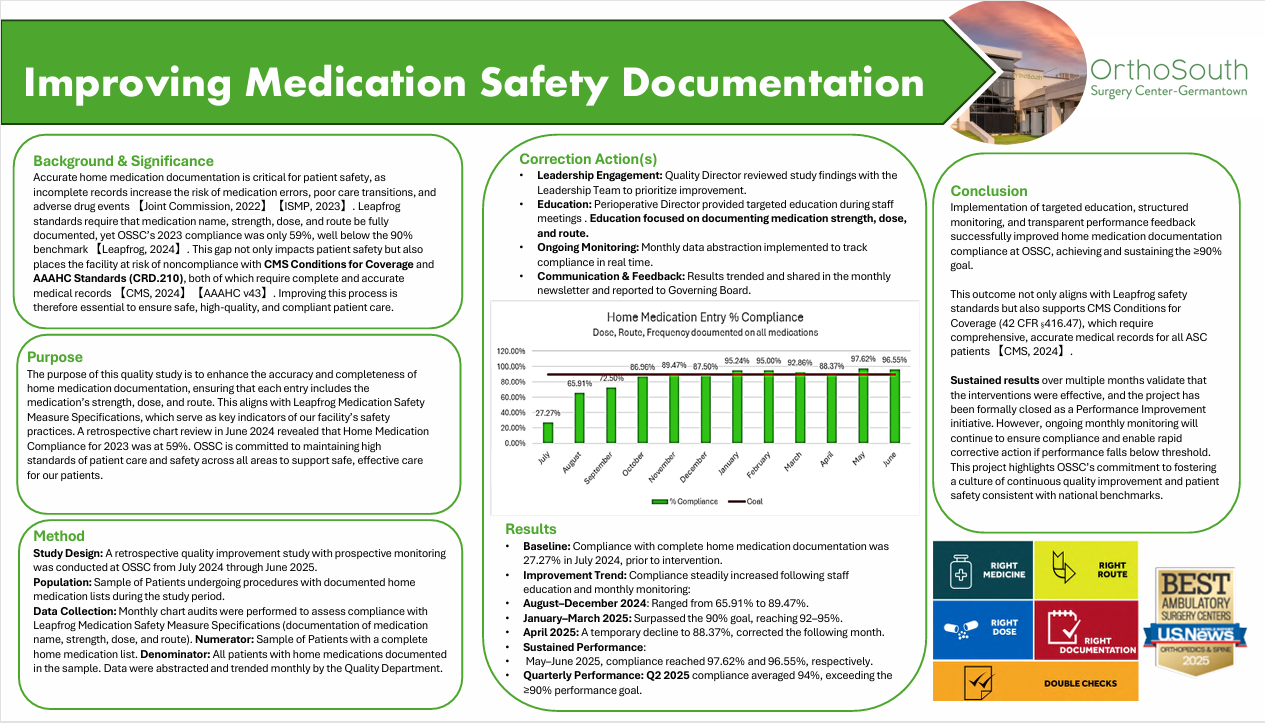
Ashley Bennet: "OrthoSouth Surgery Center – Germantown prioritized improving home medication documentation because accurate medication information is critical to patient safety across the entire surgical continuum of care. Incomplete documentation of medication strength, dose, and route can increase the risk of medication errors, impact clinical decision-making, and compromise safe transitions of care. A retrospective review revealed that only 59% of home medication records were fully complete, highlighting a clear opportunity to strengthen safety practices and align more closely with national standards."
"This initiative was also prioritized to meet Leapfrog Group Medication Safety Measure specifications, which serve as an important benchmark for high-reliability surgical care. By addressing this gap, we sought not only to improve compliance metrics but also to reinforce a culture of accountability, accuracy, and patient-centered care."
"Through targeted education, standardized expectations, and ongoing monitoring, the center achieved sustained improvement in documentation completeness, exceeding its 90% compliance goal and earning the 2025 Leapfrog Top Poster Award. Most importantly, this work strengthened the foundation for safer surgical care for every patient we serve."
Leapfrog Team: You’ve reported for 2 years now. Why is consistent reporting to the Leapfrog ASC Survey important to your surgery center?
Ashley Bennet: "Consistent participation in the Leapfrog Group Ambulatory Surgery Center Survey is important to OrthoSouth Surgery Center – Germantown because it provides a structured, nationally recognized framework that helps facilities systematically evaluate and prioritize patient safety and quality. Leapfrog’s evidence-based measures allow us to focus on high-impact safety elements—such as medication safety, infection prevention, and safe surgical practices—while ensuring our internal processes align with best practices across the country."
"By reporting consistently for multiple years, we are able to benchmark our performance against peer organizations, identify trends over time, and objectively assess where we are performing well and where improvement is needed. This longitudinal view supports data-driven decision-making and allows us to move beyond one-time compliance toward sustained performance improvement."
"Just as importantly, consistent Leapfrog reporting reinforces a culture of safety by creating transparency and accountability at all levels of the organization. It encourages leadership engagement, staff awareness, and prioritization of patient safety initiatives that have measurable impact. For our surgery center, Leapfrog is not simply a reporting requirement—it is a valuable quality improvement tool that helps guide strategic focus, foster continuous improvement, and ultimately enhance the care experience for every patient we serve."
Leapfrog Team: How has it helped to drive quality and safety improvement?
Ashley Bennet: "Consistent participation in the Leapfrog Group Ambulatory Surgery Center Survey has directly supported measurable quality and safety improvement at OrthoSouth Surgery Center – Germantown by providing clear benchmarks, defined performance expectations, and actionable data. Leapfrog’s structured measures allow us to identify specific gaps, prioritize high-risk safety areas, and track progress over time using nationally standardized criteria."
"A key example is our home medication documentation initiative. Through Leapfrog benchmarking, we identified that complete documentation of medication strength, dose, and route was an area of opportunity, with baseline compliance at 59%. Using Leapfrog specifications as the framework, we implemented targeted staff education, standardized workflows, and monthly performance monitoring. As a result, compliance steadily improved and was sustained above our 90% performance goal, achieving a quarterly compliance rate of 94% in 2025, with several months exceeding 95%."
"Beyond individual projects, Leapfrog reporting has strengthened our overall quality infrastructure by promoting routine data review, leadership oversight, and frontline engagement in patient safety initiatives. Trending data over time allows us to validate the effectiveness of corrective actions, respond quickly to performance variation, and embed continuous improvement into daily operations. Ultimately, Leapfrog has served as a catalyst for advancing a culture of safety, accountability, and evidence-based decision-making across our surgery center."
Leapfrog Team: How do you foster a culture of transparency and safety?
Ashley Bennet: "At OrthoSouth Surgery Center – Germantown, we foster a culture of transparency and safety by systematically collecting, benchmarking, and openly sharing quality and safety data with frontline staff and providers. We utilize multiple nationally recognized data sources, including the Leapfrog Group Ambulatory Surgery Center Survey and the CMS Ambulatory Surgery Center Quality Reporting (ASCQR) Program, to ensure our performance is measured against standardized, evidence-based expectations."
"Quality data from ASCQR measures and internal performance improvement initiatives are reviewed monthly and trended over time to identify opportunities for improvement and validate the effectiveness of corrective actions. In addition, participation in OrthoForum allows us to benchmark orthopedic-specific outcomes and operational performance against peer organizations nationwide, providing valuable external context."
"Transparency is reinforced by routinely reporting results to frontline staff and providers through staff meetings, leadership and medical advisory board reviews, quality dashboards, and internal newsletters. By consistently closing the feedback loop—measuring performance, communicating results, and re-measuring after interventions—we promote an environment where safety data are visible, improvement is collaborative, and patient safety remains a shared organizational priority."
Leapfrog Group: What advice do you have for other ASCs who are interested in improving medication documentation and participating in the Leapfrog ASC Survey?
Ashley Bennet: "For ambulatory surgery centers interested in improving medication documentation and participating in the Leapfrog Group ASC Survey, our advice is to integrate quality work into daily operations rather than layering on additional tasks. Begin by clearly understanding Leapfrog’s measure specifications and using them to define documentation expectations and audit criteria."
"Develop simple, easy-to-use data collection tools that align with existing clinical workflows and allow frontline staff to capture required elements in real time. Well-designed tools reduce unnecessary workload while ensuring accurate and complete data collection. Embedding these elements into routine documentation decreases reliance on retrospective chart review and minimizes the overall burden of reporting."
"Equally important is designating a key staff member, such as a Quality Nurse, to provide oversight. This role is essential for validating data accuracy, analyzing trends, and entering results into standardized formats that support clear data visualization and reporting. Centralized oversight ensures consistency while allowing frontline teams to focus on patient care."
"When combined with regular feedback to staff and providers, this approach supports sustained improvement, meaningful benchmarking, and successful participation in Leapfrog. By simplifying data capture and pairing it with focused quality leadership, ASCs can strengthen medication safety while fostering a culture of accountability and continuous improvement."
Leapfrog Team: The Leapfrog ASC Survey is changing significantly starting April 1 of this year (2026). How do these changes impact your facility? How do you think it will impact the ASC community as a whole?
Ashley Bennet: "The redesigned Leapfrog Group ASC Survey represents a meaningful shift in how quality and safety data are collected and reported, and it has a positive impact on our facility. By decreasing the amount of data that must be directly reported to Leapfrog and instead leveraging data elements already required by other entities—such as CMS ASCQR measures and national accreditation standards—the new model significantly reduces duplicative reporting. This allows our team to focus less on manual abstraction and more on using data to drive improvement."
"For our facility, the ability to rely on CMS-reported quality measures and AAAHC/TJC accreditation documentation to meet several Leapfrog reporting requirements decreases administrative burden while still maintaining transparency and accountability. Optional reporting for certain elements, such as facility procedure volumes, further supports a more efficient and sustainable approach to participation. Overall, these changes allow us to integrate Leapfrog reporting into existing workflows rather than treating it as a separate, resource-intensive process."
"Collectively, these changes support a more efficient, scalable, and impactful quality reporting model that benefits both ASCs and the patients they serve."
Leapfrog Team: Thank you for your time and leadership, Ashley! And thank you to the Orthosouth Surgery Center - Germantown for its innovative work integrating Leapfrog data collection with its efforts to improve the quality of medication documentation practices.